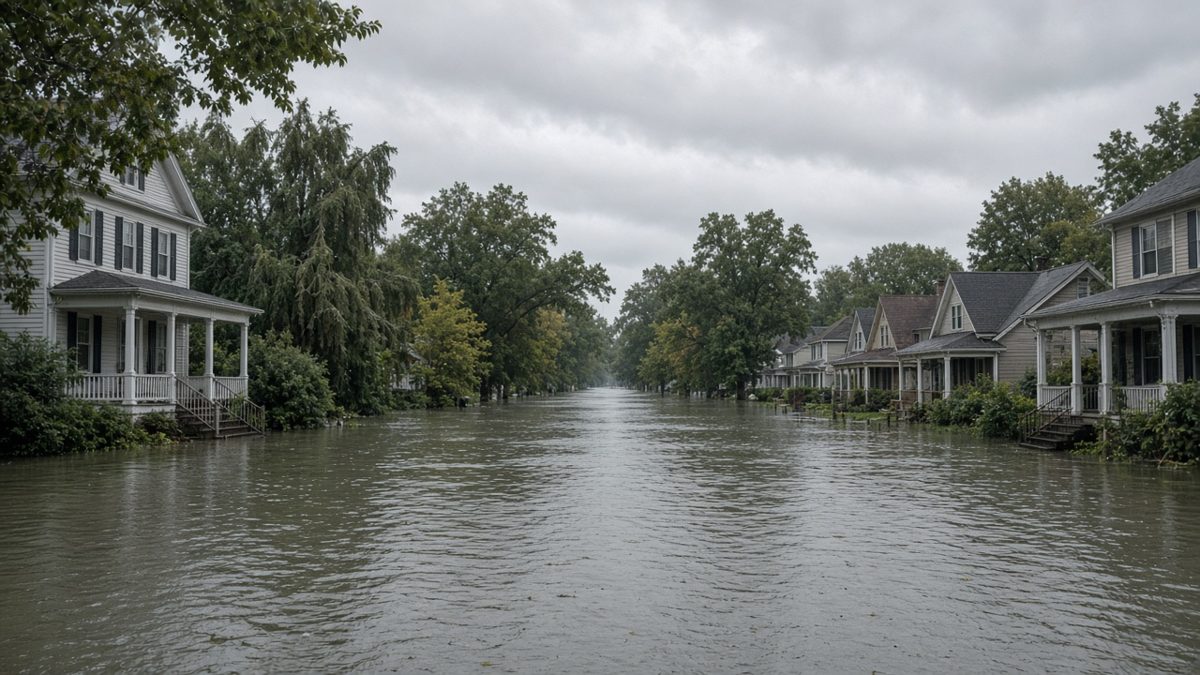
Flooding is one of the most common and costly natural disasters in the United States, and it is also one of the most misunderstood when it comes to insurance. Standard homeowners, condo, and renters policies exclude flood damage. Flood insurance is a separate purchase, sold mainly through the National Flood Insurance Program, administered by FEMA, and increasingly by private insurers. Many homeowners outside designated high-risk zones assume they do not need it, yet FEMA has repeatedly pointed out that a substantial share of flood claims come from properties outside high-risk areas.
What counts as a flood
Under NFIP policies, a flood is generally defined as a general and temporary condition of partial or complete inundation of two or more acres of normally dry land, or two or more properties, from overflow of inland or tidal waters, unusual and rapid accumulation of surface water runoff, mudflow, or collapse of land along a shoreline. In plain language, water that rises from outside and enters your home is flood. A burst pipe inside the house is not flood; it is usually a homeowners claim.
This distinction matters during hurricanes. Wind-driven rain entering through a damaged roof is typically a homeowners or windstorm claim, while storm surge that pushes water into the first floor is a flood claim. Coastal homeowners often need both types of coverage and may deal with two adjusters after the same storm.
Understanding FEMA flood zones
FEMA publishes Flood Insurance Rate Maps that classify areas by flood risk.
- Special Flood Hazard Areas. Zones beginning with A or V have at least a 1 percent annual chance of flooding, often called the 100-year floodplain. V zones are coastal areas with wave action. Over a 30-year mortgage, a 1 percent annual chance adds up to roughly a one-in-four chance of at least one flood.
- Moderate to low risk. Zones B, C, and X are outside the high-risk floodplain but can still flood, especially from heavy rainfall and overwhelmed drainage systems.
You can look up your property on the FEMA Flood Map Service Center. Maps are updated periodically, and a remapping can move a home into or out of a high-risk zone.
When flood insurance is mandatory
If you have a mortgage from a federally regulated or insured lender and your building is in a Special Flood Hazard Area, federal law requires flood insurance. The same applies to many federal disaster assistance programs: if you received federal disaster aid for flood damage in the past, you may be required to maintain flood insurance to qualify for future aid.
What an NFIP policy covers
NFIP coverage is split into two parts:
- Building property. Up to $250,000 for a residential building, covering the structure, electrical and plumbing systems, furnaces and water heaters, refrigerators and stoves, permanently installed carpeting, and foundation elements.
- Personal property. Up to $100,000 for contents such as clothing, furniture, and electronics. Contents coverage must be purchased separately; renters can buy contents-only policies.
Basements and areas below the lowest elevated floor have limited coverage. NFIP policies generally cover items such as furnaces, water heaters, and drywall in basements but exclude finished flooring, furniture, and most personal belongings stored there. Homeowners with finished basements are often surprised by this limitation.
NFIP policies also do not cover additional living expenses while you are displaced, a significant gap compared with homeowners insurance. Contents are paid at actual cash value for most policyholders, not replacement cost.
Increased cost of compliance
If your home is substantially damaged and local codes require you to elevate, relocate, demolish, or floodproof it, Increased Cost of Compliance coverage under the NFIP can pay up to $30,000 toward those costs, in addition to the building claim.
The 30-day waiting period
NFIP policies typically take effect 30 days after purchase. Exceptions exist, such as when coverage is required in connection with a new mortgage or a map revision. This waiting period is why buying flood insurance when a storm is already on the forecast rarely works. Private flood policies sometimes have shorter waiting periods, such as 10 to 15 days.
How Risk Rating 2.0 changed pricing
In 2021 and 2022, FEMA phased in a pricing methodology called Risk Rating 2.0. Rather than relying mainly on flood zone and elevation, it considers property-specific factors such as distance to water, flood frequency, types of flooding, rebuilding cost, and the elevation of the first floor. For many properties, especially lower-value homes, premiums declined, while higher-value homes in risky areas saw increases. Federal law limits most annual premium increases for existing primary residences to 18 percent, so some properties are on a glide path toward their full-risk rate.
Private flood insurance
Private flood insurers have grown substantially. Lenders are required to accept private policies that meet federal standards for coverage at least as broad as the NFIP. Private policies may offer:
- Higher building limits for expensive homes.
- Replacement cost coverage for contents.
- Additional living expenses.
- Shorter waiting periods.
- Basement coverage beyond NFIP limits.
Downsides can include less predictable renewals, since a private insurer can decide not to renew, and potential complications if you later want to return to the NFIP. Ask whether leaving the NFIP affects any discounted rate you currently hold.
Ways to lower flood insurance costs
- Elevation certificate. For older or high-risk homes, a surveyor’s elevation certificate can document that your lowest floor sits above the base flood elevation.
- Mitigation. Installing flood vents, elevating mechanical equipment, and using flood-resistant materials can reduce risk and sometimes premiums.
- Community Rating System. Communities that take part in FEMA’s CRS program by improving floodplain management earn discounts for residents.
- Higher deductibles. NFIP offers multiple deductible options.
Filing a flood claim
- Report the loss to your insurer as soon as it is safe.
- Photograph and video all damage before cleanup, including water lines on walls.
- Remove wet items to prevent mold, but keep samples of carpet and other materials for the adjuster if possible.
- Keep receipts for cleanup supplies and emergency repairs.
- Submit a signed proof of loss within the deadline, which for NFIP claims is generally 60 days unless FEMA extends it after a major disaster.
FEMA disaster assistance, when available, is not a substitute for insurance. Grants are typically limited and intended for basic, safe, and sanitary living conditions, while Small Business Administration disaster loans must be repaid.
Flood risk is changing
Heavier rainfall events, coastal development, and aging stormwater systems mean that flood risk does not stay fixed. Inland flash floods in hilly and mountainous areas and urban flooding in cities with large paved surfaces have produced major losses in places that were not historically thought of as flood-prone. Because FEMA maps reflect historical data and are updated on a cycle, they can lag behind actual conditions. Some homeowners now consult local floodplain managers, independent risk tools, and their own property history, such as past water in the crawl space or nearby streets that close during storms, rather than relying on the zone designation alone.
Questions to ask before you buy
- What are the building and contents limits, and are they enough to rebuild?
- Are contents covered at replacement cost or actual cash value?
- Does the policy include additional living expenses?
- What is the waiting period, and when exactly does coverage begin?
- How are basements and enclosures below elevated floors treated?
- If this is a private policy, does it satisfy my lender’s mandatory purchase requirement?
- Can the insurer non-renew, and how much notice must it give?
Condo and multi-unit buildings
Condominium associations in high-risk zones often buy an NFIP Residential Condominium Building Association Policy, which can cover the building up to $250,000 multiplied by the number of units, subject to replacement cost. Unit owners can purchase their own dwelling coverage to address assessments and improvements, plus contents coverage for their belongings.
Related reading: How State Minimum Auto Insurance Requirements Actually Work in the US.
Frequently Asked Questions
Do I need flood insurance if I am not in a flood zone?
It is not legally required, but properties outside high-risk zones still flood. Policies in moderate- and low-risk areas often cost less, which makes them worth pricing.
Does flood insurance cover sewer backup?
NFIP covers backup only when it is caused directly by a flood. Backup from other causes requires a homeowners water backup endorsement.
Can renters buy flood insurance?
Yes. Renters can buy NFIP or private contents coverage for their belongings, even though the landlord insures the building.
Does a condo owner need a separate policy?
Condo associations often carry a building policy, but unit owners usually need their own coverage for contents and possibly to fill gaps in the association’s coverage or special assessments.
This article is for general informational purposes only and is not legal, medical, tax, or financial advice. Rules vary by state and change over time; confirm details with the relevant agency or a licensed professional.